 Midmarket organizations usually struggle to fill a well-known gap – supporting their own evolving infrastructure needs. Their systems are the lifeline of daily operations, but their size typically puts them out of the focus of large cloud providers. As a result, these businesses often face downtime risk and limited capability to architect a “next generation” infrastructure change on their own. Indeed, they don’t lack awareness. However, they often lack access to infrastructure expertise especially in the area of business continuity, which fits their scale. CloudSAFE promises to fill in this gap.
The company primarily works with midmarket organizations in the $50 million to $500 million revenue range. Many use IBM i or AIX environments for powering insurance, manufacturing, and other customer operations. Some have moved partially into public cloud and now struggle with security gaps, uncontrolled environments, rising expenses, and failed audits.
CloudSAFE can help handle these situations efficiently. Instead of purely technology refreshes, it works to resolve business continuity problems. It helps businesses with a defined path where decisions start with downtime exposure, customer impact, and prioritizing business services. It defines responsibilities across internal teams, third party providers, and CloudSAFE itself.
 In addition, it treats backup validation and configuration monitoring as baseline requirements. CloudSAFE also makes testing and simulation a routine. This ensures demonstrable outcomes for auditors, regulators, and executive leadership.
The organizations using IBM systems can turn to CloudSAFE for disaster recovery, backup, and managed hosting. It designs recovery objectives that align well with budget realities. They deploy engineers with sound IBM expertise, which eventually helps address any skill gaps. On the other hand, organizations that are looking toward AWS or Azure can count on CloudSAFE’s managed secure cloud services.
The company helps address the specific environments’ inconsistent controls, redundant audit findings, and unexplained cost rise. It remediates them first and then operates the environment with controls enforced through automation. Moreover, it sees compliance as an ongoing state.
Sometimes, midmarket organizations hesitate to move forward into the cloud because of failed migrations or security concerns. In such cases, CloudSAFE presents itself as the operating partner. It deploys a secure and compliant foundation and takes responsibility for day-to-day operations. Consequently, internal teams can move forward risk-free.
Furthermore, fragmentation is a recurring theme across engagements. There are continuity plans documented, but mostly they are not tested. Recovery objectives are also frequently vague. On top of that, knowledge is not embedded in systems and processes. Instead, it sits with a couple of individuals. CloudSAFE helps handle this challenge.
It replaces static plans with active operating models. Besides, it maps dependencies and clearly mentions recovery targets. The CloudSAFE team conducts testing regularly so that incidents can be prevented.
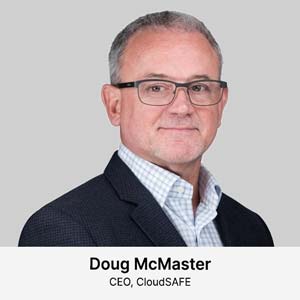
CloudSAFE is not a transformation vendor. We’re an infrastructure partner for organizations that can’t afford downtime or unresolved security gaps. – Doug McMaster, CEO.
Sometimes, organizations struggle with skyrocketing expenses after moving their workloads to the public cloud. This happens because of oversized instances, weakened governance, and storage accumulation. Keeping that context in mind, CloudSAFE includes cost control as part of managed operations. It detects waste and enforces controls, which prevent drift.
Overall, the company follows a unique principle. It believes that midmarket organizations deserve the same level of infrastructure care that giant organizations expect. That mindset reflects through the company’s high-touch service and direct access to senior engineers when needed.