 There is a moment most finance and operations leaders know well. A purchase order is somewhere in someone’s inbox. An invoice arrives without a matching PO. A department head has no idea what their team has been spending. None of this is dramatic; it just happens, silently and most often, repeatedly, until it adds up to a real problem.
Andrew Zhyvolovych built Precoro because he was convinced there had to be a better way.
Founded in 2016 and headquartered in New York City, Precoro is a cloud-based procurement and spend management platform designed to give growing companies control over purchasing that was previously only available to large enterprises with expensive ERP deployments.
The company now serves more than 1,000 businesses across 80 countries, overseeing more than $40 billion in annual procurement spend.
Precoro grew without venture capital, which is genuinely unusual in a market where procurement software vendors routinely raise nine-figure rounds. It scaled on the back of paying customers, which kept the team focused on what the product actually needed to do rather than what would look good in a pitch deck.
 That focus shows in the result.: G2 users rate the platform 4.8 out of 5, and Capterra lands at 4.7. The reviews consistently mention the same things: “easy to implement,” “easy to use,” “adopted quickly by people across operations.”
The platform covers the full procure-to-pay lifecycle. Purchase requests move through customizable approval workflows from submission to authorization automatically, routed according to budget thresholds and company policy without manual intervention.
Purchase orders are created, tracked, and sent through a single system. Three-way matching compares orders against invoices and receipts to catch discrepancies before they become payment errors.
Supplier data (contacts, contracts, performance history ) is centralized in one place instead of scattered across spreadsheets and email threads. Real-time dashboards give teams visibility into spending by department, location, or project at any point in the month, not just after the month-end close.
AI sits at the center of what Precoro has been building toward.
In 2024, the company embedded Google’s AI-powered OCR technology, which automatically extracts key data from invoices and matches them to purchase orders.
The mobile app extends this further. A team member in the field can photograph a receipt, and AI fills in the relevant details automatically before routing the expense for approval.
An AI Assistant allows procurement and finance staff to query spending data in plain language, asking about budget utilization by department or flagging invoice anomalies, without having to generate reports manually.
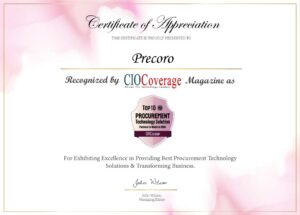
Precoro was named a Major Player in the IDC MarketScape: Worldwide AI-Enabled Procure to Pay 2025 Vendor Assessment.
The platform integrates with the systems mid-market companies actually use. NetSuite, QuickBooks, Xero, Sage, Microsoft Dynamics, SAP Business One, and Slack are all supported, and Precoro can connect with larger ERP systems through APIs.
The Supplier Portal brings vendors into the same connected environment, centralizing communication and giving procurement teams a single place to manage onboarding, approvals, and vendor information.
For companies dealing with multi-entity operations, multiple subsidiaries, branches, or locations, Precoro handles budget tracking and approval routing across all of them without requiring separate tools or manual consolidation.
Precoro has published a 2025 Procurement Benchmark Report drawing on data from more than 1,000 companies and over $40 billion in spend, giving its customers a way to benchmark their own performance against real-world peers rather than analyst estimates.
Precoro has also earned B Corp certification, an unusual credential for a SaaS company in growth mode, and has set a carbon neutrality goal for 2026.
It has been featured in the Spend Matters Spring 2024 SolutionMap for the e-procurement category, placing it among a select group of 79 vendors evaluated across source-to-pay capabilities.
It is also a Google for Startups AI Partner and holds “Built for NetSuite” Partner status.
Most procurement problems are visibility problems. Companies don’t know what they’re spending, who approved it, or whether they got what they paid for. Once you fix that, everything else follows. If a company can’t go live and see results in weeks, something is wrong with the product. — Andrew Zhyvolovych, CEO & Co-Founder
Overall, the platform is built to handle the transactional weight of purchasing automatically, so the people running procurement can spend their time on the decisions that actually move the business. In a market crowded with platforms optimized for feature lists adoption, that is read as a meaningful distinction.