
 Gigafactories are getting bigger. The blind spots inside them are getting more expensive. Cells roll off production lines at gigafactory speed while inspection technology lags somewhere in the previous decade: random sampling, outsourced CT scans that cost hundreds of dollars per cell, and end-of-line electrical tests that reveal almost nothing about what is actually happening inside. Defective ship. Packs underperform. Recalls happen. The economics gigafactories built to deliver get quietly eroded by failures no one could see coming because no one had a way to look.
Titan Advanced Energy Solutions, headquartered in Salem, Massachusetts, was built specifically to change that. Founded in 2016, it develops non-destructive, high-resolution ultrasound-based inspection systems for battery cell manufacturing, using advanced sensing technology and industrial AI to give manufacturers a real-time view inside every cell on the line.
At the center of its offering is IonSight, a purpose-built platform that integrates into existing production lines and operates at full production speed. Rather than relying on sampling, IonSight performs what Titan calls a Digital Teardown, a physics-based internal scan of every cell, delivering over 500,000 data points in under a second. It detects layer misalignment, separator tears, electrode buckling, dry zones, moisture contamination, foreign particles, and lithiation irregularities defects that conventional electrical tests routinely miss. IonSight Atlas processes more than 55 parts per minute for gigafactory-scale lines. IonSight 2.5 serves pilot lines and inbound inspection for manufacturers qualifying battery suppliers before pack integration.
The results are concrete. Process engineering teams have reduced cycle times by 20 percent through optimized electrolyte wetting and ambient aging. Yield improvements of two to five percent follow from rapid corrective actions, and time to peak yield during ramp-up accelerates by at least four percent per year.
The science rests on a physical principle: ultrasound is sensitive not just to density but to stiffness and acoustic impedance properties that shift as defects form, electrolyte distribution varies, and a battery ages. A fully charged cell is mechanically stiffer; sound travels through it faster. That relationship allows IonSight to measure State of Charge with 99 percent accuracy across NMC, LMO, and LFP chemistries. The same logic extends to State of Health detecting secondary solid electrolyte interface growth, lithium plating, dendrite formation, and outgassing, all critical in fast-charging applications. Compared to CT scanning, ultrasound is faster, safer, and captures material property variations that X-ray-based imaging regularly misses.
Industrial AI makes the platform actionable at scale. With 500,000 data points per cell per second, manual pattern recognition is not viable. Titan’s algorithms, trained on a continuously expanding library of scan data, translate ultrasound signals into quality grades, lifetime performance predictions, and process recommendations tied to corrective action at each manufacturing step.
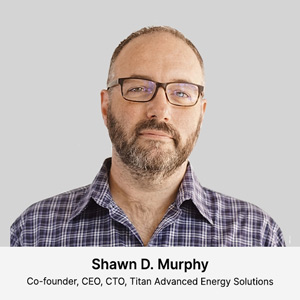
“IonSight takes quality uncertainty off the table entirely, every cell, every layer, inspected in real time. That is what the battery industry has been missing.” — Shawn D. Murphy, Co-founder, CEO & CTO
Titan has built partnerships with Honeywell and Schneider Electric, integrating IonSight into Honeywell’s Battery Manufacturing Excellence Program. In December 2024, the U.S. The Department of Energy selected it among projects advancing domestic next-generation battery manufacturing, placing Titan at the center of America’s industrial energy ambitions.
With Bob Galyen, founding CTO of CATL, on its board and technical advisors from Carnegie Mellon and Microsoft in its corner, Titan carries the credibility and industry reach to make ultrasound-based inspection a standard rather than an exceptional upgrade. As gigafactories multiply and pressure mounts to ship cells that are safe, consistent, and long-lived, Titan Advanced Energy Solutions offers the battery industry not just a better inspection tool, but a fundamentally smarter way to manufacture.