 The hardest part of running a modern business often has nothing to do with the applications themselves. It’s everything wrapped around them: change requests buried in email threads, source code scattered across environments, deployments handled manually late at night, and audit teams demanding proof of exactly what moved from development to production and when. As an IBM Business Partner, Remain Software addresses these challenges. It specializes in Application Lifecycle Management (ALM) and DevOps solutions for IBM i, while also supporting Windows and Unix/Linux environments.
Founded more than 25 years ago and headquartered in the Netherlands with a U.S. office in Norfolk, Virginia, Remain Software has built its reputation around one idea: change should be manageable, and not chaotic. Its flagship product, TD/OMS, gives development teams a single, structured way to handle software changes, testing, and deployment across every stage of the lifecycle, from initial development through acceptance and into production.
TD/OMS puts practical guardrails around everyday development work. Teams get graphical impact analysis so a single code change doesn’t quietly break something downstream, one-click rollback when an error slips through, and side-by-side source comparison and merge tools that keep every version archived and traceable. Deployment across IBM i and multiple platforms can be automated or performed manually, giving teams flexibility without sacrificing control.
Collaboration is built into the same framework. Peer review, workflow automation, user approval, and management sign-off happen through a ratification process, so nothing reaches production without the right eyes on it. Teams sourcing code from multiple vendors can synchronize it automatically through Remain’s Fusion capability, and every component change is logged into a central database, producing audit-ready reports for compliance requirements like SOX with little extra effort.
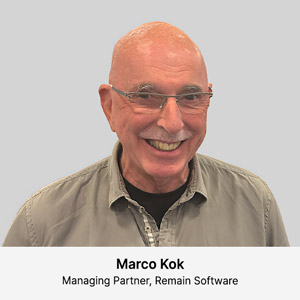
“We’re thrilled for the ongoing success of companies that came to us seeking clarity and direction, and continue to rely on us to guide them into the future,” — Marco Kok, Managing Partner
TD/OMS connects with widely used platforms including Jenkins, Git, GitHub, GitLab, Bitbucket, JIRA, ServiceNow, and OTRS, along with 4GL environments such as LANSA, CA 2E, CA Plex, and GeneXus. This connectivity means IBM i teams aren’t forced to choose between legacy stability and modern tooling; they get both working together.
 Remain Software’s portfolio extends well beyond change management. MIWorkplace offers developers a modern, integrated development environment as an alternative to green-screen interfaces. Gravity brings structured project and workflow management to teams juggling multiple initiatives across platforms. Remain API Studio lets developers design, build, and test REST APIs using JSON and OAS standards, opening IBM i data to modern applications. Octo, the company’s newer web and Visual Studio Code-based dashboard, extends TD/OMS with server-state analysis and trend reporting. X-Analysis and Xref give organizations detailed, interactive insight into application dependencies, while the Journal Analyzer simplifies tracing data changes back to their source. ReplicTest rounds out the suite with automated, end-to-end testing across interactive, batch, and web applications.
This combination of depth and breadth has earned Remain Software long-standing relationships with organizations like Yamaha Motor Europe, Resurs Bank, Achmea, and Accell IT Services, many of whom point to the same thing: responsive support paired with software designed to support reliable, long-term application lifecycle management. Backed by a global network of partners and resellers, the company continues to expand its integrations and refine its tools to match how development teams actually work today.
As IBM i environments continue to evolve alongside cloud, DevOps, and multi-platform development, Remain Software’s approach, built on control, collaboration, and connectivity, gives organizations a practical way to manage that change on their own terms, without disrupting the systems already running their business.