

 Every electric vehicle on the road today carries a problem its driver rarely thinks about. The battery pack weighs hundreds of pounds, limits range, and relies on chemistry that is reaching its limits. Lithium-ion was never designed for today’s demands, from long-haul EVs to advanced defense and AI applications. The ceiling is real, and the industry knows it. What it has been waiting for is a company with both the science and the manufacturing logic to break through it. Factorial Energy, based in Billerica, Massachusetts, is that company.
Its roots trace back to Cornell University, where the foundational research began in 2013. Factorial itself was incorporated in 2019, carrying more than a decade of materials science work into a focused commercial mission: build solid-state batteries that are lighter, safer, more energy-dense, and manufacturable at the scale automakers and defense contractors actually need. Today it holds over 150 patents and patent applications, partners with Mercedes-Benz, Stellantis, Hyundai, and Kia, and has cells operating in real vehicles.
The flagship platform is FEST®, the Factorial Electrolyte System Technology. It combines a lithium-metal anode, a quasi-solid polymer electrolyte, and a high-capacity cathode into a quasi-solid-state cell that delivers meaningful gains in range and a significant reduction in weight over conventional lithium-ion. What makes it commercially compelling is a detail that sounds almost too practical for a deep-tech story: It is 80 percent drop-in compatible with existing lithium-ion production lines. Partners can adopt the technology without rebuilding factories. In 2024, Factorial shipped 106 Ah Automotive B-Sample cells to several global OEMs, marking a major commercialization milestone.
Solstice™ approaches the same problem from a different angle. Its zero-liquid, sulfide-based electrolyte stays stable above 90°C, a thermal threshold that opens doors conventional cells cannot enter. A dry-coating manufacturing process keeps production costs and energy consumption down, resulting in a meaningfully cleaner environmental profile. The platform serves electric vehicles, consumer electronics, and grid-scale energy storage. The clearest proof of what it can do came when a Mercedes-Benz EQS powered by Factorial solid-state cells covered 749 miles on a single charge and crossed the finish line with range still displayed.
Gammatron™ is the third piece of the stack, and arguably the least visible to the outside world despite doing some of the heaviest lifting. It is an AI and machine learning platform that constructs a digital twin of the battery modeling how electrolytes behave, monitoring cell health, refining fast-charge performance, and supporting battery management systems. Work that once consumed months of physical lab time now takes a fraction of that time.
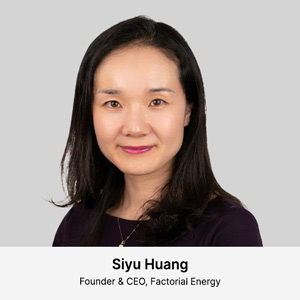
“We are advancing energy storage beyond what was once thought possible. Automotive, defense, robotics all need better energy storage, and that is critical to American competitiveness.” — Siyu Huang, Founder & CEO
 Factorial’s market has grown well past the automotive sector. Its solid-state cells are being built into defense and drone platforms through partnerships across three continents, and its collaboration with IQT the venture organization that deploys capital on behalf of U.S. national security reflects how seriously government and defense circles are now treating battery technology as a strategic priority. A production partnership with Karma Automotive in early 2026 marked the first solid-state battery program for passenger vehicles to move into U.S. production. A business combination with Cartesian Growth Corporation III, with the SEC registration declared effective in May 2026, sets up the company’s next chapter as a publicly listed entity.
The manufacturing philosophy running beneath all of it is straightforward: transformational technology should not demand transformational disruption from the people adopting it. With a commercial approach designed to work alongside the industry, Factorial enters 2026 with significant momentum.