
When AI finishes before the organization does
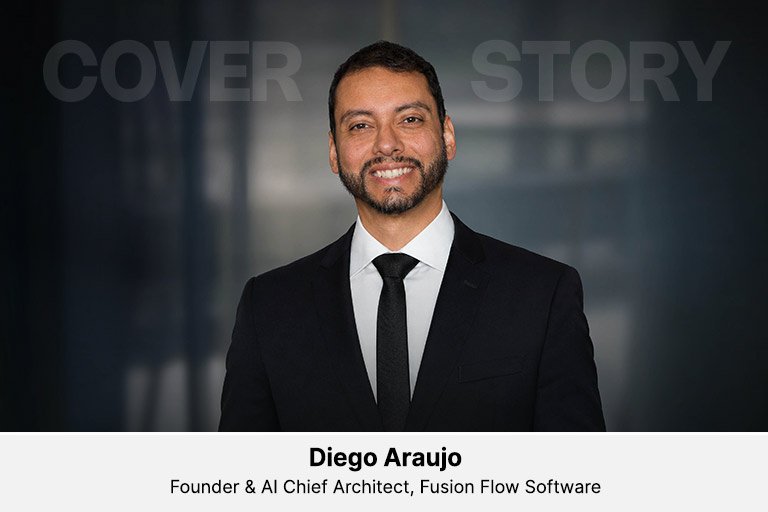
Diego Araujo, enterprise AI architect and founder of Fusion Flow Software, on turning AI capability into work people can finish.
An AI agent can finish an assignment while the organization around it is still passing the request between departments. Diego Araujo works with clients and senior leaders to close that gap. His work spans business applications, systems integration, cloud infrastructure, and applied AI.
Rolling out assistants does not mean a business has redesigned its work. Models have moved on, but the processes he examines can still reflect what AI could do two years ago. Access to the technology is only the start; the harder question is how to bring it in safely. The next step is to rework one business domain around the outcomes agents can carry through.
He starts with the decisions behind the delays. What work belongs together? Who owns the result? What can an agent do independently, and what must it bring back to a person?
Question the handoffs
Araujo challenges the assumption that every existing step deserves to be automated.
“A faster handoff is still a handoff. I want to know whether it needs to exist.”- Said Diego Araujo, Founder & AI Chief Architect.
Some handoffs transfer a decision to someone with the right authority. Others simply move information between people who each own a small piece of the work. Removing the second kind can let one person own a broader outcome, with agents carrying connected tasks through to completion. He points to the full-stack engineer, who builds both what users see and the systems behind it, combining work once split among specialists. He expects knowledge work to follow, with employees using agents to own a result from start to finish.
His starting exercise for a leadership team is to follow one request from arrival to completion. At each transfer, identify the judgment, information, or permission being added. Then examine the transfers that add none. What the remaining transfers add becomes the agent’s charter. Give it the outcome, the rules it must follow, the people it must escalate to, and the data it may use.
A new company can design this way from the outset. An established enterprise has to dismantle processes built before AI that no longer serve the work. He looks to teams designed around AI for lessons that can travel back to older operations.
The next bottleneck may sit outside the company. A faster internal process still waits on a supplier, customer, or legacy system. Redesign therefore includes helping partners change, rather than measuring only how quickly the agent finishes.
Treat shared agents as software
An agent has to work for someone other than the person who built it. “A useful test is whether that person can take a day off without the workflow taking one too,” Araujo says.
 He asks who will maintain an agent before a promising demonstration becomes a shared dependency. A named owner and backup must know what it can touch and rerun representative work when its instructions, connections, or capabilities change.
That also shapes the choice between building and adopting a product. Reproducing an interface is the easy part. He asks whether the internal team can sustain the maintenance and quality assurance that follow, and keep pace with a product that improves every week.
Instructions and examples belong somewhere the team controls. Leaving each employee to rebuild them creates repeated work; maintaining them once gives the organization something it can improve. Training includes requests the agent cannot safely complete because information is missing, records conflict, or a decision requires approval. Knowing when to stop is part of knowing how to use it.
Test the work people will entrust to it
A successful demonstration establishes potential; evaluation must reveal where the system breaks.
 Araujo ties evaluation to the decisions the business wants to delegate. A customer communication must preserve the facts; figures headed for a leadership meeting must be correct. He tests with the hardest real requests, including ones with incomplete information and conflicting records. Does the agent expose what it cannot establish, or present uncertainty as finished work?
He separates rare, consequential failures from invented scenarios with little connection to the business. Teams that test the latter can end up designing for them, while overlooking the work people actually need to finish.
“A confident answer doesn’t grant permission to act,” he says. Reading a message, drafting a reply, and sending it require separate permissions. Before expanding autonomy, he asks which failures remain and where a person must intervene. He holds back expansion when the business cannot answer.
His rule of thumb for leaders is to divide the effort evenly: half on capability, half on security, governance, and observability. The second half establishes who may authorize an action, what the agent may touch, and how its actions can be traced. A policy document alone does not make those controls operational. He sees agent governance as unfinished work. An enterprise cannot wait for a ready-made framework; it has to build and test controls in its own operations.
Own what your agents learn
Trust has two parts: does the agent do the work correctly at scale, and who keeps what it learns along the way?
The most useful context may never be typed into a prompt. Documents, messages, and records already reveal what people are trying to finish. With permission, an agent can use that context without asking someone to reconstruct it each time.
As agents interact with employees, they also encounter reasoning and practices that may never have been written into a formal system. That knowledge can be a competitive advantage. A business needs control over where it resides, how it is used, and what remains available when it changes models. “You should be able to change the model and keep what you’ve learned,” he says.
More context does not justify unrestricted collection. Before supplying customer information, a business should check what the provider retains, who can access it, and how it may be used. Unneeded data creates exposure for both sides, so when the need is unclear, it stays out. Araujo expects an agent to remain useful with limited access and to ask or stop when missing information prevents safe completion.
That brings him back to the request still moving between departments. The measure is whether the person responsible can carry it through, with fewer handoffs and less time spent explaining the business again. Araujo says, “What interests me is the work people can now finish that used to stall.”