
Hybrid work solved its software problem years ago. The hardware behind it- laptops, monitors, and tablets moving through homes and time zones- has been managed manually for far longer, and closing that gap is why Retriever was founded, and why it’s emerged as one of the best workplace tech solutions for hybrid and remote teams.
Retriever started with the hardest, least glamorous piece of the puzzle first: getting laptops back. Before it was founded, the same scene played out at every company. An employee would leave, and an IT or People team member would spend weeks chasing down a laptop from someone with no incentive to return it, with no chain of custody, tracking, or accountability. That fragmentation was the real insight: these were never five separate problems but one lifecycle nobody was treating as a lifecycle. The vision became a single, trusted, automated partner that owns a device’s entire life from first boot to certified end-of-life.

Retriever is a device lifecycle management platform that handles retrieval, storage, redeployment, and disposal of company laptops. Retriever’s foundation now anchors a complete lifecycle platform built around one principle: no subscriptions, just prepaid laptop-return credits that never expire, one credit per retrieval. The company sums up its position simply: the trusted leader in laptop retrieval, now offering complete lifecycle solutions across international retrieval, storage, deployment, and disposal. More than 8000 customers now run their hardware programs through Retriever, including over 1000 enterprise customers such as Anthropic and OpenAI. That trust reaches beyond AI, spanning tech, healthcare, and other industries with distributed remote workforces. Every device that moves through the system is tracked through the Retriever portal, one of the company’s biggest differentiators, where customers can trigger a retrieval, deployment, or disposal in a few clicks, follow every shipment, and pull reporting and certificates of data destruction on demand. The platform is SOC 2 Type II certified, and every device wipe meets military-spec standards under NIST 800-88.
That need only grows as work spreads across cities, countries, and employment models. Every stage of the employee lifecycle- onboarding, in-life swaps, offboarding, storage, and disposal- now carries a physical logistics problem attached to it, and a single unrecovered laptop represents real data-security and compliance exposure. Retriever’s answer is to become the automated layer underneath all of it, so customers manage their entire fleet through the Retriever portal instead of chasing devices and coordinating shippers themselves.
Customer outcomes show the model working at every scale. SANDOW, a fully remote global marketing and media firm, once had corporate hardware scattered across the private residences of three different IT team members, a setup that turned new-hire provisioning into a constant scramble and offboarding into a manual chase for tracking numbers and confirmations. After integrating Retriever’s API directly into its internal systems, SANDOW cut its hardware management time by 90%, eliminating the scrambles altogether and reclaiming the physical space those devices had occupied in its team members’ homes.
MERGE, a technology and marketing agency with a workforce of 500 to 1,000 employees across multiple North American offices, faced a similar bottleneck at greater scale: stacks of unprocessed hardware, fragmented inventory visibility, and an IT team bogged down sourcing boxes and tracking shipments by hand. What began as simple laptop retrievals grew into a full warehousing and redeployment partnership, giving MERGE a single source of truth for offboarding returns, new-hire deployments, and device swaps. Technology lead Mike Shaw reports being 90% less stressed about device returns and redeployments since the partnership began, calling Retriever less a vendor than a seamless extension of his own IT team.
At Flourish Health, a healthcare provider, the offboarding process once ran through the CTO’s home, where departing employees’ laptops were shipped to be manually wiped and redeployed, an inefficient use of executive time and a real security risk. Retriever’s retrieval services moved that burden off the CTO entirely, letting HR initiate recoveries with a few clicks. Separately, Flourish Health connected Retriever’s API directly to its Electronic Health Record system to solve a different problem: distributing tablets to its patient population, previously run through a fragmented mix of emails and spreadsheets. That integration automated patient device distribution end to end. Between the two changes, the team estimates it has reclaimed at least ten hours a week previously lost to logistics and follow-up.
“We took the most anxiety-ridden, invisible, someone-else’s-problem part of modern work and made it feel completely handled.” – Craig Swill, CEO.
Internally, that philosophy comes down to one rule: automate the process, humanize the moments. Anything repeatable and rules-based, generating labels, scheduling pickups, tracking, status updates, triggering data-wipe workflows, runs invisibly through automation across the US, the UK, and Canada and reaches further still through Retriever’s International Program, which builds a custom quote for every cross-border request, a retrieval in Australia headed to Spain, a deployment in Argentina landing in Germany, so no country is outside the network. But for moments where judgment and empathy matter more than speed, like an unresponsive former employee, a damaged-device claim, or a tricky customs situation, a real person stays in the loop, backed by a dedicated Slack channel that’s just one message away.
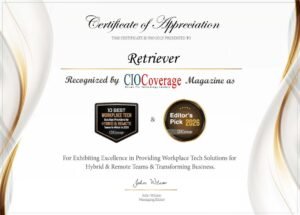
The retrieval-to-redeploy engine is Retriever’s clearest differentiator. Most competitors entered the category from the easy end, shipping new laptops out and treating retrieval as an afterthought. Retriever did the opposite. It mastered recovery first, building the rest of the lifecycle on that hard-won trust. Because it already holds recovered devices in hand, it can clean, wipe, reinstall, and turn them back into deployment-ready inventory for new hires instead of customers buying new hardware. That alignment, where the most affordable option for the customer is also good for Retriever, lowers cost, extends each device’s usable life, and feeds a sustainability story worth noting: every laptop recovered and redeployed is one that doesn’t need to be manufactured, and every device that reaches true end-of-life goes through certified, responsible recycling instead of a landfill. Doing right by the planet and budget, in this model, turns out to be the same action.
Retriever sees that combination- chain-of-custody discipline, aligned incentives, and customer-friendly economics with no lock-in contracts- as the foundation of a bigger shift. Workplace infrastructure has always been described in software terms, but the physical layer- every device procured, configured, delivered, recovered, secured, and retired across borders and compliance regimes- has been largely ignored and mostly improvised. The next generation of that infrastructure should behave like cloud software: on-demand, automated, fully visible, and secure by default, so that getting a laptop to a new hire abroad or recovering it when they leave just happens, the way spinning up a server does.
Looking forward, Retriever plans to deepen that automation globally, building toward the same automated experience the US, the UK, and Canada already have. The longer-term goal is making the portal the definitive system of record for a company’s entire distributed hardware fleet, surfacing intelligence on the fleet as a whole, including value recovery at end of life.