
 IT teams today deal with a growing number of tools, alerts, and disconnected systems that rarely share information. Plant floor data lives in one dashboard, network performance sits in another, and service tickets build up faster than staff can triage them. Engineers spend hours chasing root causes across separate platforms while outages and performance issues surface only after they’ve already affected the business. ScienceLogic solves this by giving IT operations teams a single platform that observes, advises, and automates across hybrid environments in real time.
Founded more than two decades ago and headquartered in Reston, Virginia, ScienceLogic is the agentic AI engine behind the modern IT landscape. The company’s mission is to unify observability, AI and automation into a single system that anticipates, prevents, and resolves issues before they negatively impact the end user, freeing up engineering resources to focus on innovation. This has helped ScienceLogic become one of the fastest-growing AI companies to watch this year as enterprises, service providers, and government agencies turn to the platform to modernize operations.
 ScienceLogic AI Platform drives this growth and is built upon three pillars: Service-Centric Observability, AI-Driven Operations, and Intelligent Automation that combine to consolidate disparate tools into a single service-aware dashboard providing insight on infrastructure, topology, configuration and performance across hybrid environments. Customers can deploy on-premises, in the cloud, hybrid or via ScienceLogic SaaS in a matter of hours.
Skylar One serves as the company’s core observability offering, providing a unified view across hybrid and multi-vendor environments. It connects fragmented data silos, contextualizes infrastructure across complex systems, and accelerates root cause analysis so teams can act on accurate information instead of piecing it together manually.
Skylar Automation is a low-code/no-code orchestrates workflows across IT ecosystems at scale, cutting manual toil and moving organizations closer to autonomic IT. Skylar AI act as the platform’s intelligence layer, applying unsupervised machine learning and reasoning to enhance both observability and automation, helping enterprises shift from reactive monitoring to proactive, self-managing operations. Skylar Compliance brings network resilience, enforcing policy standards and configuration management across multi-vendor devices and servers, while Skylar Analytics and the newly introduced Skylar Advisor convert alert noise and operational knowledge into prioritized, explainable guidance that helps teams resolve issues faster.
 Value is being delivered across the board with customers reporting a 66% reduction in incidents, an 85% increase in productivity, and 100% service availability. One customer saw a 93% reduction in MTT Repair and $2.5 million in cost savings, while a Forrester Total Economic Impact™ study found that the ScienceLogic Platform provides customers with 157% ROI.
Industry analysts have taken notice as well. ScienceLogic has been named a Leader in The Forrester Wave™: AIOps Platforms report, earning the highest score in the Strategy category, and recognized in the Gartner® Magic Quadrant™ for Observability Platforms. The company also holds a FedRAMP Moderate Authorization, reflecting its reach into public sector IT operations.
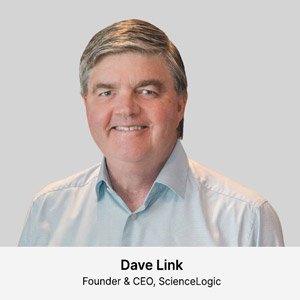
“What started ScienceLogic was a passion to help IT professionals, and that passion is still with us each and every day.” – Dave Link, Founder & CEO
This passion is driving ScienceLogic’s push to expand across the observability, automation and compliance space, leveraging the agentic power of AI to continue delivering on its mission to help enterprises and service providers worldwide. With a growing customer base across enterprise IT, managed service providers, and government agencies, ScienceLogic should continue to see strong growth as organizations look to consolidate their IT management stack into a single-pan solution rather than use a series of disparate tools.