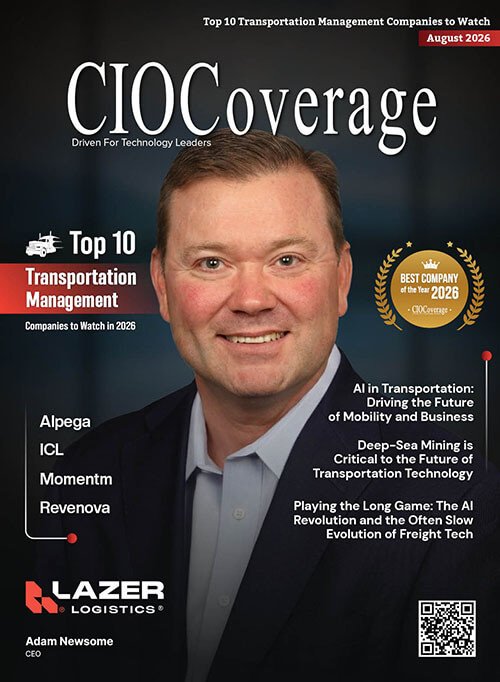
Top 10 Transportation Management Companies to Watch in 2026
Transportation Management’s Shift From Execution to Decision Support
Transportation management software once existed to record what already happened: a truck departed, a rate was booked, an invoice arrived. That function is changing. Platforms once limited to tracking freight now guide routing, pricing, and carrier selection before a shipment leaves the dock.
Global TMS spending will reach nearly $14.9 billion by 2031, up from $9.7 billion in 2026. Cloud-based, API-connected platforms are replacing on-premise systems at scale, and North America accounts for the largest share of that growth as e-commerce volume rises and compliance rules tighten. Europe is moving on a parallel track, driven by new digital freight rules and emissions-reporting requirements that are now shaping how carriers and shippers plan routes.
Adoption still outpaces readiness in parts of the supply chain. Tariff volatility and cross-border trade have made freight auditing and carbon tracking daily priorities. However, many shipping networks still price loads using spreadsheets and rate sheets that lag current market conditions by days.
Generative and predictive AI now address this problem directly. Vendors are building these tools into core platform functions, not separate features, to surface live lane pricing, flag compliance exceptions, and automate manual freight matching.
The vendors that lead over the next five years will be measured less by the volume of data their systems collect and more by how fast that data turns into a decision a dispatcher, broker, or shipper can act on.
Top 10 Transportation Management Companies to Watch in 2026
Alpega Group is a global leader in logistics SaaS software, dedicated to delivering comprehensive end-to-end solutions for all transport requirements.
Cargoo
Vincent Ducaroir, CEO
Cargoo is a unique collaboration platform that enables end-to-end transportation procurement and planning, real-time data synchronization, and execution to drive process efficiencies and lower costs.
FreightWise
Chris Cochran, CEO
FreightWise combine agile TMS technology with deep industry expertise to provide transportation management services, and software to shippers of all shapes and sizes.
By understanding the unique business needs of our customers, ICL has become a leading provider of systems solutions configured for the demands and challenges of the finished automotive supply chain.
Lazer Logistics has led outsourced yard logistics since 1996, evolving from a single spotter truck into an operation spanning 800+ sites. Its 30-year story reflects the transformation of the yard itself, from an overlooked handoff point into a connected, technology-enabled part of the modern supply chain.
Loadsmart
Felipe Capella, CEO
Loadsmart offers logistics solutions powered by industry experts and next-gen technology that lower costs, increase efficiency, and digitize transportation.
Momentm Technologies is a dedicated Health & Human Services Transportation software company, built on a powerful foundation of 30+ years of industry-leading experience inherited from TripSpark and Trapeze.
project44
Jett McCandless, Founder & CEO
With intelligent transportation management, end to end visibility, yard management and last mile solutions, project44 connects over 1.5 billion shipments annually for over 1,000 leading brands in manufacturing, automotive, retail, life sciences, food and beverage, CPG, and oil, chemical and gas.
Our goal at Revenova is to simplify your shipping operations and maximize efficiency by putting co-workers, customers, and partners together on one agentic cloud platform.
TransImpact
Berkley Stafford, CEO
TransImpact delivers intelligent transportation and supply chain solutions that unlock measurable savings and total cost visibility for the two most expensive aspects of operations – logistics and inventory.