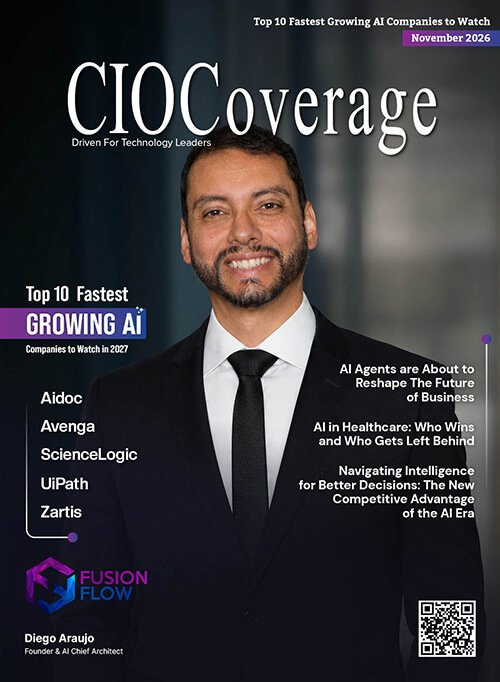
Top 10 Fastest Growing AI Companies to Watch in 2027
Agentic AI Moves From Pilot Projects to Enterprise Infrastructure
Businesses have been testing the waters with AI agents in the last two years, seeing autonomy as a function to test rather than an enterprise system to run. Task-specific AI agents are poised to power 40% of enterprise applications by the end of 2026 (vs less than 5% a year ago), according to Gartner. Today, businesses demand agentic features as the default in any new software they purchase, not as an innovation.
The market has the stats to prove it: with a value of near $3.67 billion in 2025, the enterprise agentic AI segment is projected to grow past $24.5 billion by 2030 with more than 46% CAGR. McKinsey says 88% of companies are using AI in some way, and 23% have scaled AI agents within a business function, showing the gap between aspiration and achievement.
The move from testing to everyday use has real costs beyond the balance sheet. IDC says that nearly 90% of AI pilots never become generally available, usually due to governance, data quality and data ownership problems being identified too late in the process. Gartner predicts that by 2027, more than 40% of agentic initiatives will be ended due to lack of risk management and that security and compliance functions will pay the price for experimentation without a clear mandate.
The companies that win the most will be the companies that build agentic AI into their core operations, rather than bolting it on as an experiment. Which means governance and oversight from day one, not after an agent is acting on live data. The next phase of enterprise AI will be led by companies that define success by how many workflows they run on their own, not how many pilots they started.
Top 10 Fastest Growing AI Companies to Watch in 2027
Aidoc is a pioneering force in clinical AI. We focus on aiding and empowering healthcare teams to optimize patient outcomes, which results in improved economic value and clinical outcomes.
Avenga is an international AI Engineering firm helping businesses transform by embedding intelligence at the core of how they build, think, and run.
Celigo
Jan Arendtsz, Founder & CEO
As automation demand grows and AI raises expectations, many organizations hit the same wall. Celigo gives IT the visibility, control, and reliability it needs to run automation in production, while enabling business teams to build and manage the workflows they rely on every day.
Darktrace
Ed Jennings, President & CEO
Darktrace is a global leader in AI cybersecurity, providing the essential cybersecurity platform to secure organizations today and for an ever-changing future.
Fusion Flow Software helps senior leaders cut through handoffs, departmental silos, and outdated processes that delay work. Combining business applications, systems integration, cloud infrastructure, and applied AI, it helps teams own results from start to finish, with security, compliance, and clear rules for agent actions.
Geniusee
Taras Tymoshchuk, CEO
We help SMBs and enterprises replace costly legacy systems with scalable, AI-powered digital platforms, improving operational efficiency and accelerating time-to-market through cloud-native and data-driven solutions.
Riverbed Technology
Dave Donatelli, CEO
Riverbed is the only company with the collective richness of telemetry from network to app to end user that illuminates and then accelerates every interaction so that users get the flawless digital experience they expect across the entire digital ecosystem.
ScienceLogic is a leader in AI and Observability, providing modern IT operations with actionable insights to predict and resolve problems faster in a digital, ephemeral world.
UiPath develops AI technology that mirrors human intelligence with ever-increasing sophistication, transforming how businesses operate, innovate, and compete.