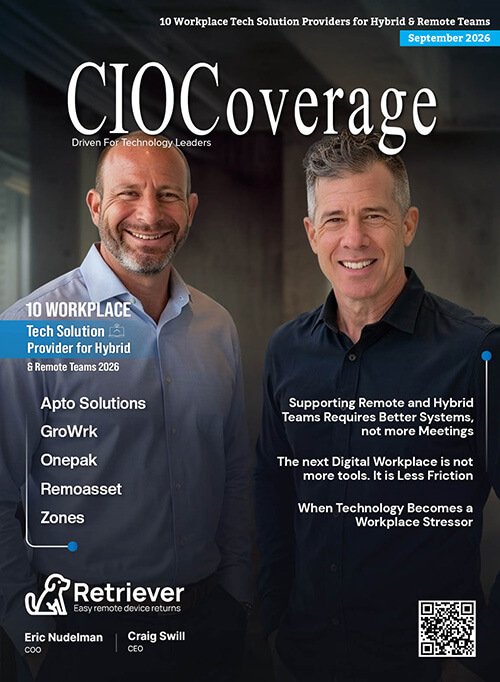
10 Best Workplace Tech Solution Providers for Hybrid & Remote Teams to Watch 2026
Hybrid Work Has Redefined IT Asset Management as a Business Priority
Hybrid work moved company hardware out of offices and into homes, co-working spaces, and city apartments. Laptops, phones, and monitors now travel further and change hands more often than IT teams can easily track. More than 70% of companies today operate under hybrid work schemes, and the physical extension of enterprise technology has expanded far beyond what traditional inventory systems were built to handle.
The market research for IT asset management will see the global market grow from roughly $2.09 billion in 2025 to $3.01 billion by 2031, representing a compound annual growth rate (CAGR) of more than 6%, as enterprises buy infrastructure to track distributed hardware rather than centralized systems. Capability has struggled to keep up with this increase, as recently published industry surveys estimate that only 20% of companies achieve the level of asset management needed to deeply integrate tracking with IT service management, leaving device history, ownership records, and license data scattered across disconnected systems.
This disconnect carries consequences beyond inconvenience. Unreturned devices raise compliance exposure, unaccounted hardware inflates costs, and security teams increasingly require documented proof of where every asset sits and who controls it, rather than assumptions carried over from office-based routines.
Companies that consider asset visibility as infrastructure rather than an enhancement to the IT lifecycle will find themselves ahead of the curve, better equipped for the next wave of distributed work and enabling rapid onboarding and offboarding of devices while maintaining the necessary paperwork for auditors. The enterprises best positioned for the future of work will measure success by how confidently they can report on every device in circulation, rather than the number of devices purchased.
10 Best Workplace Tech Solution Providers for Hybrid & Remote Teams to Watch 2026
Apto Solutions is a trusted leader in IT Asset Disposition (ITAD), delivering innovative, client-focused solutions designed to meet the dynamic needs of large enterprises.
Esevel
Yuying Deng, CEO
The IT Management Platform That Actually Works. Stop juggling multiple IT vendors, customs delays, and manual processes. We transform distributed IT operations from overwhelming complexity into simple, automated workflows.
GroWrk is building the infrastructure for the future of work. Our technology platform and global logistics infrastructure help distributed companies deliver and manage laptops, devices, and other equipment and services to their remote teams faster and more efficiently than they can do on their own.
Onepak is a reverse logistics technology company that connects and manages the return, recovery, and reuse of IT assets through a unified digital ecosystem.
Oomnitza
Robert Potter, CEO
Oomnitza is the Trusted Intelligent Asset Data Layer that continuously reconciles asset intelligence across hardware, software, SaaS, and cloud. It feeds verified data into the platforms where decisions, workflows, and AI actions take place.
Remoasset provides global laptop procurement, laptop retrieval, logistics and local storage solutions backed by end-to-end IT asset lifecycle management, helping companies seamlessly manage and support devices across the Americas, Europe, APAC, and the Middle East.
Retriever is a trusted leader in laptop retrieval, offering complete device lifecycle solutions including international retrieval, storage, deployment, and disposal. Founded by engineers and product leaders from Dropbox, Google, Stanford, and UC Berkeley, it makes device returns fast, secure, and stress-free for businesses and employees.
Rippling
Matt MacInnis, President & CPO
Rippling is a workforce management system that eliminates the friction from running a business. Today, most companies struggle with everything from routine tasks, like running payroll, to cross-functional planning, like aligning on headcount.
ZenAdmin
Aditya Anand, Co-Founder & CTO
From startups to Enterprise, ZenAdmin helps you Manage your people, devices, and apps in one place. From procurement to IT support and device retrieval, we automate everything so you can scale efficiently and securely worldwide.
Zones is a Global Solution Provider of end-to-end IT solutions with an unmatched supply chain. Positioned to be the IT partner you need, Zones, a Minority Business Enterprise (MBE) in business for over 35 years, specializes in Digital Workplace, Cloud & Data Center, Networking, Security, and Managed/Professional/Staffing services.